
Why enterprise AI rarely reaches the P&L, and what the companies that get there have in common
By Jukka Märijärvi, Partner, Quatromine · Enterprise AI diffusion series, part two
This is part two of a series on enterprise AI diffusion in Europe: getting AI out of pilots and into how whole companies work. In part one I wrote about NBIM, which has done it. This time the question is why most companies have not.
Europe has its own reason to care. As Nicolai Tangen said at AI Forum Europe in Paris in June, Europe is behind in chips, models and cloud infrastructure, and its opportunity is the application layer. That opportunity only becomes real when AI changes how companies work and shows up in their earnings.
Adoption itself is moving fast. According to Eurostat, 20% of EU enterprises with ten or more employees used AI in 2025, up from 13.5% a year earlier. Among large enterprises the figure was 55%. Use is still narrow, though. Only 8.3% of EU enterprises used three or more types of AI technology. In McKinsey’s 2026 State of AI survey, 44% of respondents say AI is now scaling across their enterprise, up from 38%. Companies are working on it. What it does to earnings is another question.

Photo: Jukka Märijärvi
Adoption is not value
Every board I speak with has an AI programme. Staff have the tools, pilots are running, and there are clear wins, usually within a limited scope. The target is typically efficiency, and efficiency is welcome.
But efficiency only goes so far, and it tends to stay inside one part of the organisation. AI is happening, yet very few companies can show, or even intuitively say, what it does to earnings.
The survey data points the same way. In McKinsey’s survey, 37% of respondents attribute at least some impact on EBIT (operating profit) to AI, roughly the same share as a year earlier. Only about 6% are what McKinsey calls high performers: organisations that attribute 5% or more of EBIT to AI and describe its impact as significant. That share was also flat, while most respondents expect their organisations to keep increasing AI investment.
A smaller data point from Gartner fits the picture. In a webinar poll of 137 CFOs and finance leaders in March 2025, 74% reported time savings from AI, but only 11% said their organisation had seen financial value from it in 2025. A poll of that size is an indication rather than a measurement. Still, Gartner’s own summary is hard to argue with: time saved is not money saved.
This is the diffusion problem again, seen from the P&L. So the question for 2026 is no longer whether companies adopt AI. It is whether AI earns back what it costs, and more.
Why pilots don’t add up
The pattern is familiar. The board wants AI and gives the CEO a budget. The CEO cascades it through the organisation, and each unit starts its own pilot. And what do the pilots have in common? Nothing. Every pilot is a reasonable decision on its own, but nothing changes across the company.
Meanwhile, the costs accumulate: per-user licences, the running cost of the models, integration work, and pilots nobody switches off. The cost scales across the company. The benefit stays in the unit.
What the winners do differently
Among McKinsey’s high performers, nearly three in four have fundamentally redesigned workflows because of AI, against one in four of other respondents. The winners didn’t buy better LLMs (large language models). They changed the work around them and put AI into core business processes rather than into individual departments. In my experience, that means processes such as order-to-cash, production planning or claims handling. NBIM did the same thing. The CEO owns the change, and the core work has been redesigned.
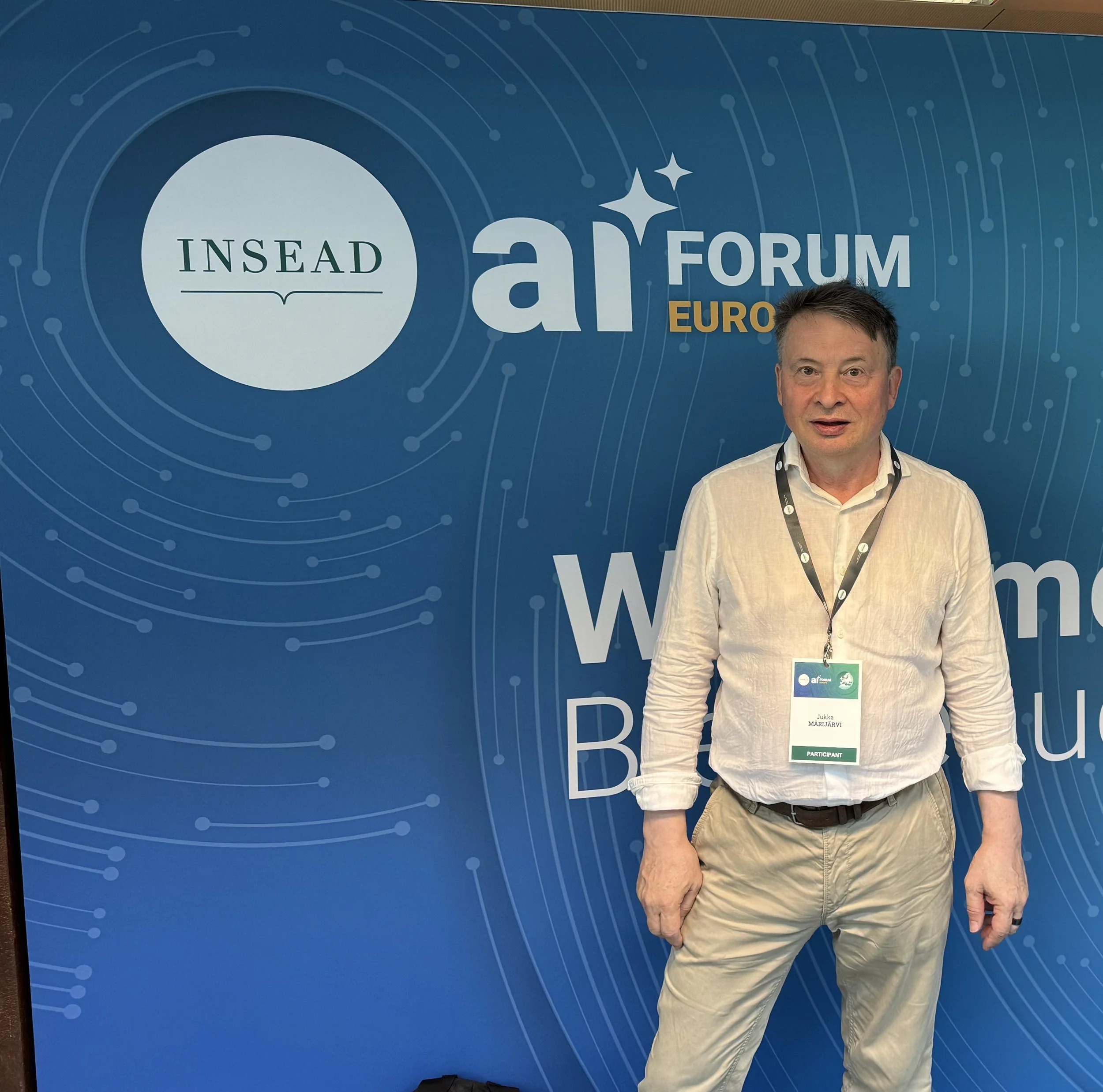
Photo: Jukka Märijärvi
A different perspective
Real impact takes more than LLMs. AI needs to be embedded in core business flows, not in organisational units. But how? That is what the rest of this series is about.
Part of the answer is leadership and workflow redesign, as NBIM shows. Another part is enabling technology. Beyond the models themselves, companies need AI-capable tools, solutions and infrastructure that work inside the processes that run the business, not alongside them. Many of these are being built today by small companies and startups. That enabling layer is where we focus at Quatromine.
Most companies are not there yet. NBIM shows that the gap can be closed, but for now it is the exception.
At Quatromine, we are concentrating on this problem and will have more to say about it. If you are working on solutions, or looking for them, we would like to hear from you. Get in touch with me at jukka.marijarvi@quatromine.com, with any of our management team, or through the contact page at www.quatromine.com.
Sources
Eurostat, “20% of EU enterprises use AI technologies”, 11 December 2025 (2025 EU survey on ICT usage and e-commerce in enterprises): https://ec.europa.eu/eurostat/web/products-eurostat-news/w/ddn-20251211-2
Eurostat, “Use of artificial intelligence in enterprises”, Statistics Explained: https://ec.europa.eu/eurostat/statistics-explained/index.php?title=Use_of_artificial_intelligence_in_enterprises
Eurostat, dataset isoc_eb_ai (indicator E_AI_TGE3): https://ec.europa.eu/eurostat/databrowser/view/isoc_eb_ai/default/table
McKinsey & Company, “The state of AI in 2026: On the road to ROI”, 25 August 2026 (survey of 1,719 participants, 4 May to 8 June 2026): https://www.mckinsey.com/capabilities/quantumblack/our-insights/the-state-of-ai
Gartner, Gartner Business Quarterly 1Q26, “Walking the Golden Path to AI Value” (source: 2025 Gartner CFO Leadership Series webinar poll, 4 March 2025, 137 CFOs and finance leaders): https://emt.gartnerweb.com/ngw/globalassets/en/insights/gartner-business-quarterly/documents/gartner-business-quarterly-1q26.pdf
Gartner, 2025 IT Symposium/Xpo keynote takeaways: https://emt.gartnerweb.com/ngw/globalassets/en/chief-information-officer/documents/2025-itsym-keynote-takeaways.pdf
